

Regular route holes
The lift cord passes through a hole punched in the middle of every slat. Closed, each hole is a dot of light, and from outside a lit room they line up into a visible column.
Privacy Blinds
Ordinary blinds have a row of holes through every slat where the lift cord runs. Close them at night and a lit room shows those holes to the street. SmartPrivacy® hides the route holes and tightens the closure. PAPABLINDS installs it on faux wood, wood, and aluminum blinds in Seattle, Bellevue, Kirkland, and Redmond.
Two blinds, both closed. The difference is the route holes and how far the slats overlap.
The lift cord passes through a hole punched in the middle of every slat. Closed, each hole is a dot of light, and from outside a lit room they line up into a visible column.
The route holes move to the back edge of the slat, out of sight, and the slats close tighter against each other. What is left is a solid face with no dots.
On a winter evening the room is lit and the street is dark, which is when route holes show most. With SmartPrivacy® the window reads as a plain surface.
Any window that faces a neighbor or a sidewalk within a few feet, which in Seattle, Kirkland, and the denser parts of Bellevue and Redmond is most side windows. Ground-floor bedrooms, bathrooms with a window in the shower wall, and the home office that looks straight into the house next door.
SmartPrivacy® is not blackout. It closes the pinholes and tightens the slats; light still comes in at the edges of the blind when the sun is high. For a bedroom that must be dark at 5 a.m. in June, a shade behind the blind or a DayNite™ shutter does that job.
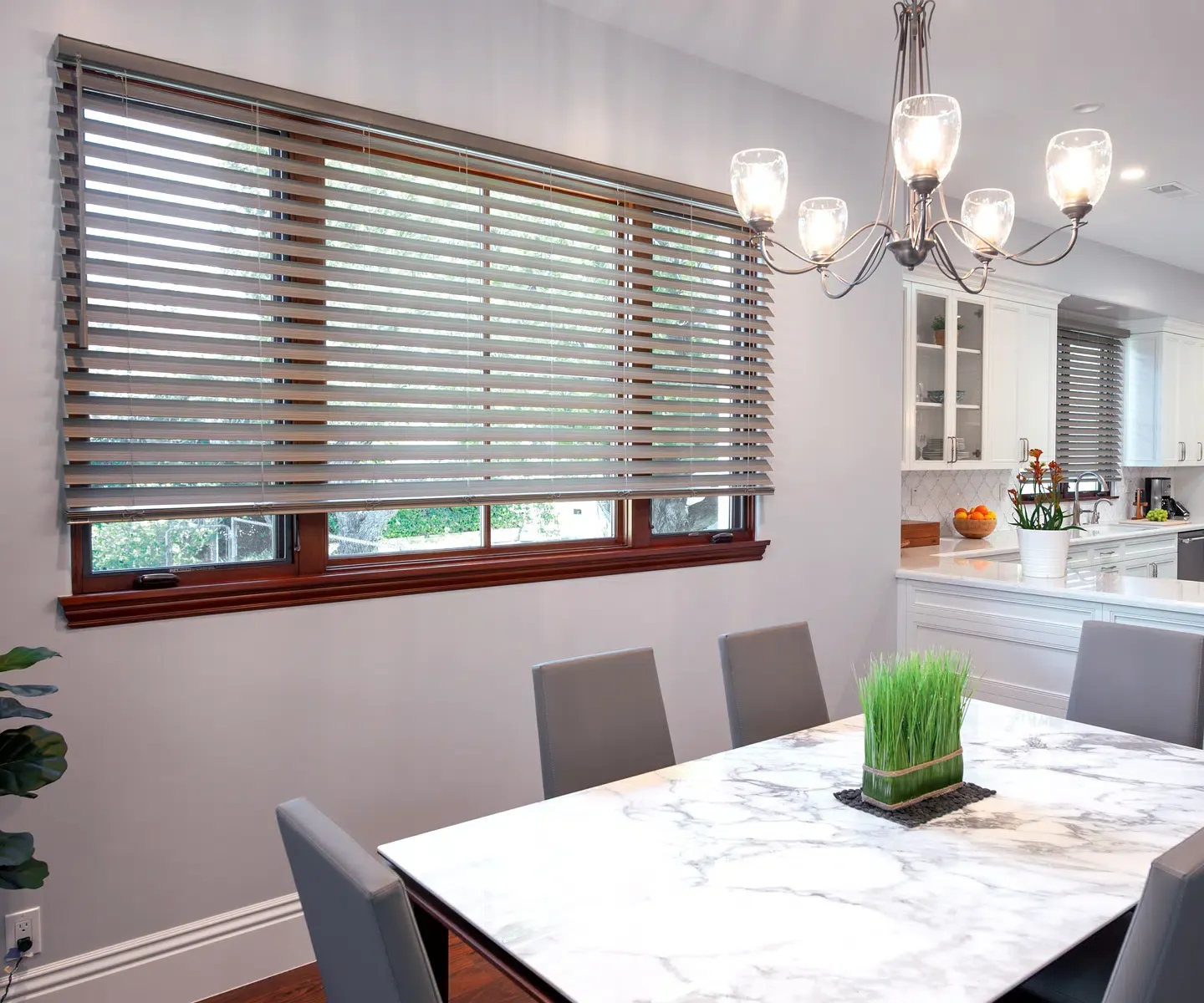 © 2021 Norman®. All Rights Reserved.
What each option does with the blind closed, in plain terms.
| Option | Route holes | Light at the edges | Best for |
|---|---|---|---|
| Regular blind | Visible dots on every slat | Yes | Windows nobody looks into |
| SmartPrivacy® blind | Hidden | Small | Bedrooms, bathrooms, side windows |
| SmartPrivacy® plus a blackout shade | Hidden | None | Nurseries, shift workers |
| Blackout shutter (DayNite™) | None | None | Bedrooms that also want shutters |
Blackout shades are on the shades page; the shutter version is on blackout shutters.
No. It is a feature of the blind: the route holes are moved to the back edge of the slats and the closure is tightened. On Ultimate™ Faux Wood and Normandy® wood blinds it comes with the blind; on CityLights™ aluminum it is an option on the 2 inch slat.
No. It removes the pinholes and most of the light between slats. A little light still enters at the sides of the blind and where the bottom rail meets the sill. For a fully dark room, add a blackout shade or choose a DayNite™ shutter.
With the slats tilted up, daylight comes in and the view from outside is blocked at eye level. That is the everyday setting for a bathroom or a ground-floor bedroom.
Both close tightly. The 2 inch slat has more slats per window and slightly more overlap; the 2 1/2 inch slat opens the view more when tilted. We show both closed at the visit.
Seattle lots are narrow and Eastside townhouses sit close together, so the side windows of most homes look into another house. A blind with regular route holes gives the room away at night: every slat shows a dot of light where the cord passes through. SmartPrivacy® blinds hide those holes and close tighter, and PAPABLINDS installs them on faux wood, wood, and 2 inch aluminum blinds in Seattle, Bellevue, Kirkland, Redmond, and nearby communities.
These are the windows people ask about first. For a bathroom the answer is a SmartPrivacy® faux wood blind: moisture-resistant slats, cordless lift, and a closed face at night. For a ground-floor bedroom it is the same blind or its wood version, and if the room also needs to be dark for sleep, a blackout shade mounted behind the blind or a DayNite™ shutter.
Tilt the slats up toward the ceiling. Light comes in off the top of each slat, and anyone outside at eye level sees the underside of the slats and nothing else. It is the setting most of our customers leave the blind in all day.
A blind gives you the tilt: privacy and daylight at the same time. A room-darkening or privacy shade is either up or down. If the window is one you adjust through the day, the blind wins; if it stays closed, a shade costs less. We bring both to the visit.
Request a free in-home visit and we close a SmartPrivacy® sample in your window so you can see the difference from the sidewalk.
Norman® product names, marks, and photos are used for product education. ™ and ® denote trademarks owned or claimed by Norman®. Norman-supplied photos: © 2021 Norman®. All Rights Reserved.