

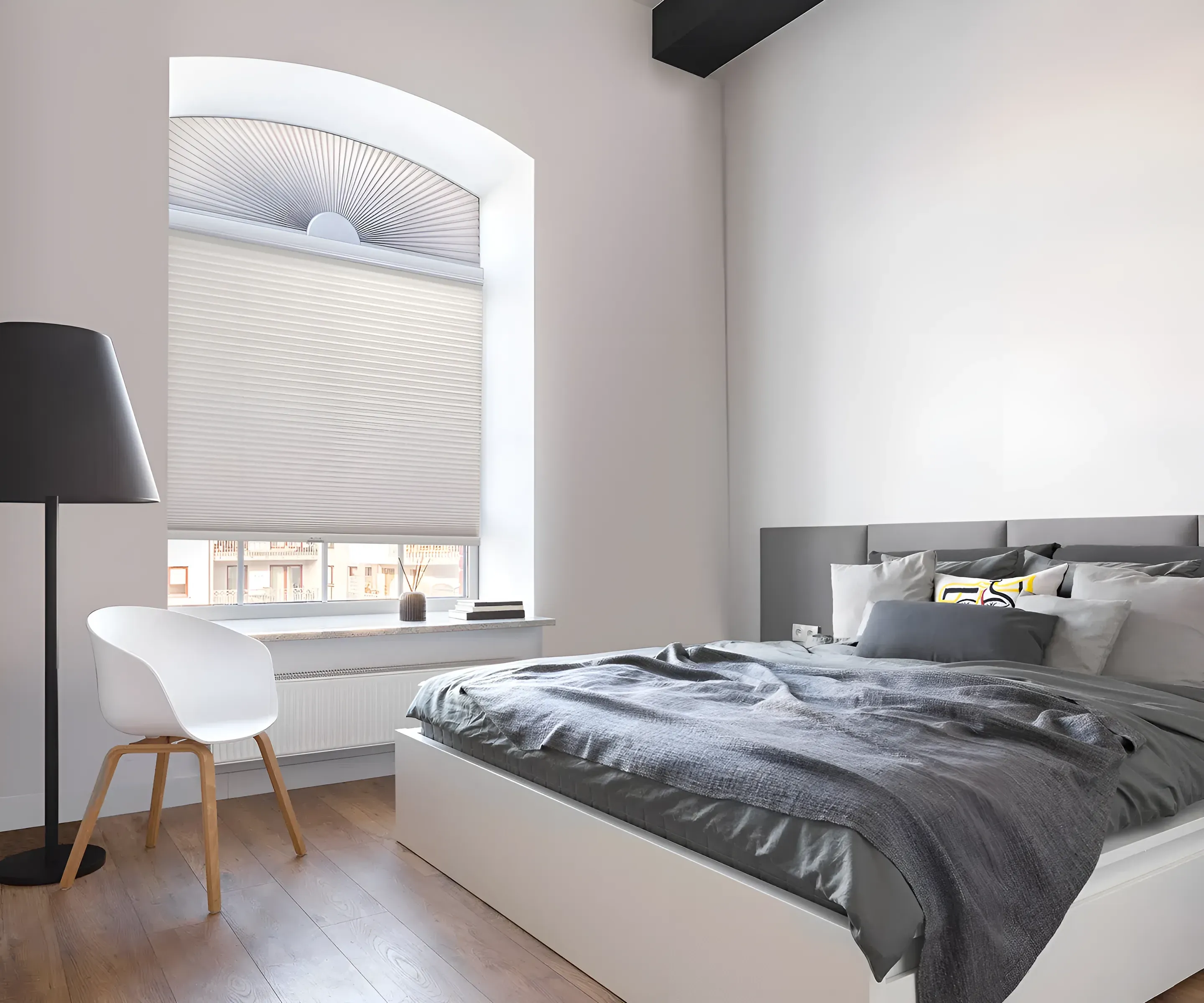
Warm and dark
Room-darkening cells with side channels for sleep, insulation for the window over the bed.
Cellular Shades
Honeycomb cells trap air against the glass, which is why cellular shades are the shade we recommend first for cold bedrooms and drafty older windows. Portrait™ honeycomb shades in six cell sizes and over 150 fabrics, measured and installed by PAPABLINDS across the Greater Seattle Area.
Seen from the side, the fabric is a row of hexagonal cells. Each cell holds a pocket of still air between the room and the glass, and still air is a poor conductor of heat. That is the whole trick: in January the room side of the shade stays closer to room temperature, and in July less of the afternoon sun gets through as heat.
Norman’s Portrait™ shades use a D-cell construction that keeps the pleats crisp instead of sagging over the years, and a double-cell option adds a second row of air pockets for the coldest windows. Single-pane windows in older Seattle homes are the textbook case.
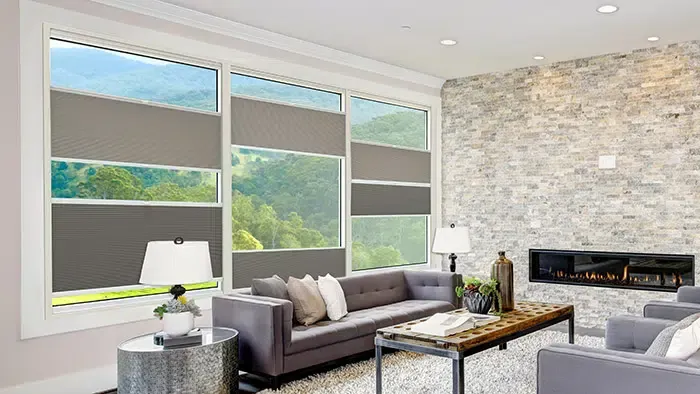 © 2021 Norman®. All Rights Reserved.
Smaller cells suit small windows and a finer pleat; larger cells suit tall windows and stack more compactly.
Room-darkening cells with side channels for sleep, insulation for the window over the bed.
A wide window loses heat all winter. Cellular fabric cuts the draft you feel from the sofa.
A light-filtering cell softens the window behind the screen and keeps the room bright.
SmartRise™ cordless lift, certified Best for Kids, with nothing to pull or loop.
Fabric opacity decides how the shade behaves with the sun up and the lights on.
| Opacity | Daytime | At night with the lights on | Rooms |
|---|---|---|---|
| Sheer | Softens the view, most light | Silhouettes visible | Living rooms, dining rooms |
| Light filtering | Glow, no view in | Privacy | Most rooms, offices, kitchens |
| Room darkening | Dark, light at the edges | Privacy | Bedrooms, nurseries, media rooms |
| Room darkening with side channels | Dark | Privacy | Bedrooms that must be dark |
For the full blackout options across shade types, see blackout shades.
Top-down bottom-up gets its own page: top-down bottom-up shades.
They reduce heat loss through the glass, and on single-pane or older double-pane windows the difference is noticeable from the sofa. We do not quote a percentage: it depends on the window, the fabric, and how often the shade is down. Double cells and side channels get the most out of it.
Double for the coldest windows and for bedrooms; single for everything else. Double cells stack a little thicker when raised, so on a small window the single cell often looks better.
Yes: motorized bottom up, top-down bottom-up, Day and Night, and skylight versions. Power and charging access are confirmed at the visit.
Dust with a soft brush or a vacuum on low with the brush attachment. Spot-clean with a damp cloth. The cells are not meant to be soaked.
Cellular shades, also called honeycomb shades, are the shade we recommend most often for Seattle-area bedrooms and for the older windows in Ballard, Wallingford, and Queen Anne craftsman homes. The cells hold still air against the glass, which keeps a room warmer in a wet January and cooler in a July heat wave. Norman’s Portrait™ line comes in six cell sizes, single and double cell, and over 150 fabric colors. PAPABLINDS measures and installs them in Seattle, Bellevue, Kirkland, Redmond, and nearby communities.
The 9/16 and 3/4 inch single cells are the everyday choice and fit most windows. The 3/8 inch cell suits small windows and door panes, and the 1 1/4 inch cell suits tall windows where a bigger pleat looks right. Double cells in 1/2 or 3/4 inch add a second layer of air for north-facing rooms, single-pane glass, and bedrooms.
SmartRise™ cordless lift is the standard: no cords, certified Best for Kids. Top-down bottom-up lowers the top of the shade for daylight while the bottom stays up for privacy, the setting most of our bathroom and street-level customers use. Motorized versions run from a remote or an app and are worth it for tall windows and for rooms with more than three shades.
Blinds tilt; shades lift. If you adjust the window through the day for glare, a blind gives finer control. If you want insulation, a soft look, and one motion to open or close, a cellular shade wins. Many homes use both: cellular shades in the bedrooms, faux wood blinds in the kitchen and bathroom.
Request a free in-home visit and we bring cell samples and fabric swatches to hold against your own windows.
Norman® product names, marks, and photos are used for product education. ™ and ® denote trademarks owned or claimed by Norman®. Norman-supplied photos: © 2021 Norman®. All Rights Reserved.